A nonprofit’s business development runs on relationships its people spent years earning. Custom AI automation made room for more of them, without faking a single word.
Custom AI for business development at a nonprofit
Tracy Powell-Rudy has spent over 14 years building relationships that are critical to Integrate-ATI. She persuades large employers to build autism-at-work programs and hire the neurodivergent college graduates who could thrive in them. Integrate-ATI is a small nonprofit, yet its partnerships suggest an organization many times its size. Each relationship is a product of trust built over that 14-year period.
Tracy’s are not the only relationships the organization runs on. Marcia Scheiner, who founded Integrate before the merger that created Integrate-ATI and now chairs its board, holds relationships critical to its large clients. The board extends the network further: its members include people who represent current and past clients, and people whose own networks can bring in new business.
Growth is where that model strains. Standard outreach software would have the team loading contacts into sequenced templates, and people who took years to earn would start receiving messages that read like everyone else’s. Standing still has a cost too: business development moves exactly as fast as a handful of calendars. So when Integrate-ATI’s leadership talked about scale, the requirement sounded odd out loud. The organization needed more of its people. The project started with Tracy.
“Nothing about Integrate-ATI’s business model looks like a typical sales cycle,”says Colin Willis, co-founder of Corymb, who joined the organization’s board in 2025 after years of working with Tracy on hiring outcomes for neurodivergent job seekers. “The business needed a way to scale their business development efforts, which essentially meant make more of Tracy. I think a lot of businesses have that problem.”
The raw material was already in her hands. Tracy keeps a LinkedIn network of more than 5,500 connections, curated one by one across her career. That network is a business development dataset most organizations would envy, and until this year, turning it into partnerships meant manual effort: research each contact, write each message, keep each thread warm. The hours for that work did not exist. Corymb took the project on pro bono, as a mission worth backing and a working demonstration of what the firm builds for small teams.
The version that came first
Colin started where a technical consultant would. He built a system that ingests Tracy’s LinkedIn export into a small database, where Python scripts label each contact so the AI works from clean summaries instead of rereading thousands of rows. Campaign tools pick the contacts best matched to a goal and assign message variants for testing; when fresh data arrives, the system analyzes what worked, and the next campaign starts from those lessons. Every draft must match a voice profile distilled from years of her own sent messages. The Claude for Chrome extension types each draft into LinkedIn and saves it, unsent.
“Really cool, very technically complex,” Colin says of that first version. “And that’s the bit that came second.”
The bigger problem sat in plain sight. Nobody on Tracy’s team is technical in the way the tool is technical. She and her colleagues were what Colin calls turn-based AI users: AI as a question-and-answer chatbot. She had never opened Claude. A system that needed an engineer on call would make more of Colin, and that wasn’t the assignment.
“The key was to make the upskilling only what was essential. Not a lecture but a tutorial.”
A project that assembles itself around you
So he inverted the design. In most AI workspaces the person directs the machine. Here, the project teaches the person. A user on the team types “Help me with my LinkedIn outreach,” and the assistant checks what exists, builds a plan, and asks for what it needs: the LinkedIn archive, the Chrome connection, the decisions that belong to the user. Prebuilt walkthroughs cover every setup step, including the tool connections that usually stop non-technical users cold.
“It’s like having someone who has done this exact work a hundred times sit down with you and walk you through it, step by step,” Colin says.
“By the end of the walkthrough, it’s like you’ve put on a mech suit and can do anything, and you don’t realize it was assembled around you as you answered its questions.”
The first task the assembled suit performed was reading Tracy’s own writing back to her. Before drafting any outreach, the system studies the user’s sent messages and produces the voice profile that all future drafts must match. Tracy heard her style described and, in Colin’s telling, was “very amused by it.” The profile, he says, “was really accurate.” It also keeps learning, because she pushes back on it line by line. “Every time I tweak something a little bit, I went back and said, look at my first line, I’m saying let’s say this now,” she told Colin after her first campaign session. “And it’d be like, okay, yeah, that sounds more like you.”
The rule in bold
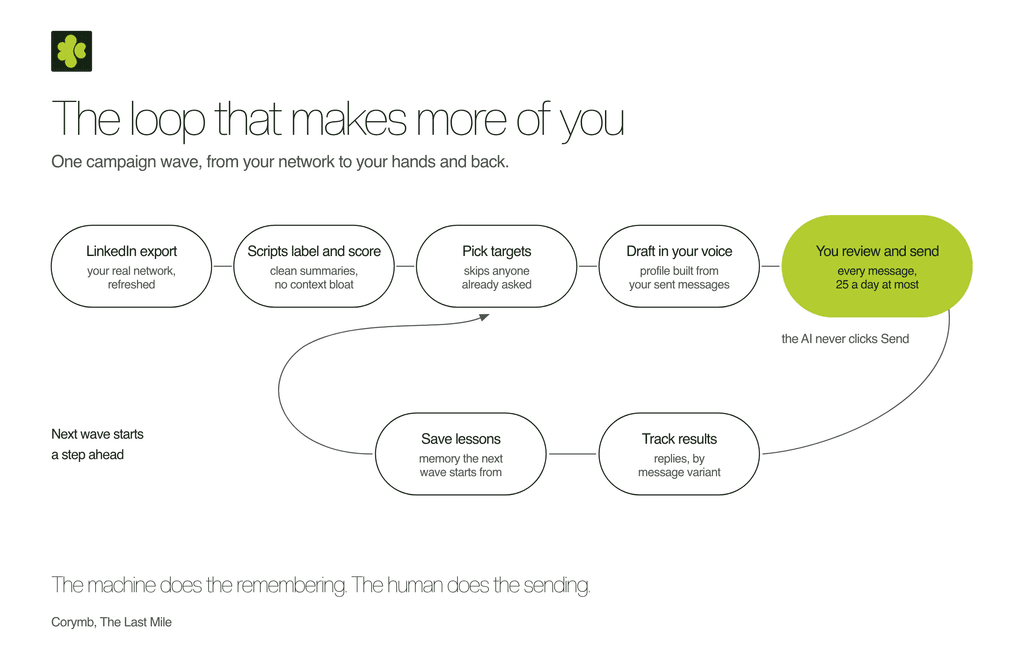
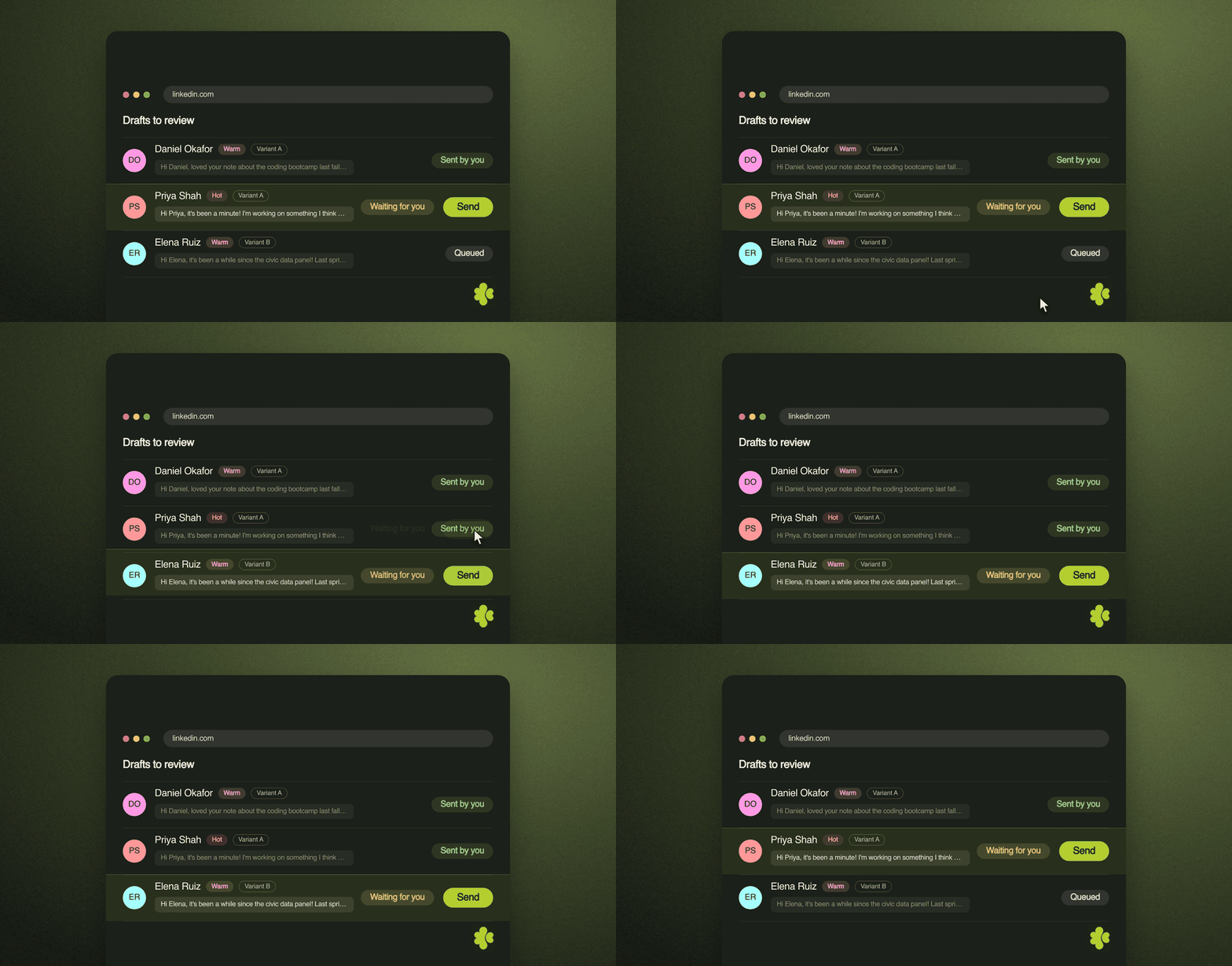
One rule in the project’s instructions appears in bold: the AI never clicks Send. It types the draft into LinkedIn and stops. The user reads every message and sends it personally, twenty-five a day at most, paced over weeks. An automation vendor would call that cap a lost sale. Colin wrote it in on purpose, because the account, the relationships, and the words all belong to the user.
“Tracy’s connections are super important to her and her work,” Colin says. “She’s not going to send AI slop to anyone, ever.” The tool does its work before the send button enters the picture: mapping which parts of her network fit a campaign, planning and testing message variants, speeding up the writing itself. “Tracy is in the driver’s seat the whole way, and the work is authentically hers. There’s just more of her to go around now. Her impact is bigger.”
Why a chat window couldn’t do this
A reasonable question: couldn’t someone get the same help by pasting their LinkedIn data into any AI chat? For a while, yes. The model would read the export and draft decent messages. The trouble arrives a few sessions later. Chat histories erode. Old data mingles with new inside a bloated context, and the model starts confusing details it handled cleanly the week before. Researchers have measured this pattern: a 2024 peer-reviewed study titled “Lost in the Middle” showed that language models lose track of information buried in the middle of long contexts.1 People who use AI this way often leave disappointed. They expected the AI to learn from them, and a chat window has nowhere to keep the learning.
The outreach project treats learning as something to engineer rather than hope for. Campaign history lives in files the AI reads deliberately. Repeatable steps live in scripts instead of in a conversation’s fading memory. The design expects new data, tests outcomes against it, and carries the lessons into the next wave. Tracy sends better messages each round, informed by real analytics, and none of that upkeep lands on her desk. For once, AI works the way she expected.
The stakes reach past one nonprofit. An MIT report on enterprise AI, published in 2025 as The GenAI Divide, found that roughly 95 percent of corporate generative-AI pilots showed no measurable return, and traced most failures to tools that neither retain feedback nor fit the way people already work.2 Most of those pilots had capable technology. They died in the last mile: the distance between a working tool and changed daily work.
What happened
The first campaign ran in July, recruiting corporate partners for Integrate-ATI’s fall Employer Connect program, a 90-minute virtual event where employee volunteers meet talented neurodivergent college graduates for mock interviews and small-group networking. Tracy worked in batches of ten messages, and the tool did the remembering around her. It removed nine contacts she had already messaged from her first list, flagged overseas profiles that made no sense for the campaign, and asked about edge cases instead of guessing. When a reply landed mid-session, it spoke up. “It’s like, hey, heads up, somebody’s just responded. Do you want to take a look?” she recounted the next morning. “That was cool.”
By that second morning she was also assigning the tool work nobody had planned for it. When a colleague asked for a spreadsheet of all outreach activity, she gave the job to Claude. “The good news is I don’t have to do it. I can ask Claude to.” The tool then suggested replacing her free-text status column with a five-choice dropdown. “Thank you,” she said, “for being my editor as well.”
She kept going without Colin, which was the result he watched most closely. He walked her through setup one afternoon and checked in the next day, and she had gone from never having opened Claude to running campaigns on her own. A second team member has since adopted the tool, which tested the design’s central claim. Nothing in it is specific to one person; it assembles itself around whoever answers its questions. Vance Checketts, Integrate-ATI’s CEO, says the project’s positive impact reached beyond Tracy, to him, Marcia, and chief operating officer Amanda Marino.
Colin has a name for what the project actually optimizes.
“It’s high-quality efficiency. Not how many messages you can send, but how much of you can there possibly be.”
See more of the tool here.
References
- Liu, N. F., Lin, K., Hewitt, J., Paranjape, A., Bevilacqua, M., Petroni, F., & Liang, P. (2024). Lost in the middle: How language models use long contexts. Transactions of the Association for Computational Linguistics, 12, 157–173. https://doi.org/10.1162/tacl_a_00638
- MIT NANDA. (2025). The GenAI divide: State of AI in business 2025 [Preliminary findings report]. Massachusetts Institute of Technology.