

Hirevue budgeted a week of consultant time for every job analysis. The workflow automation Colin built cut it to about an hour, and the system still runs without him.
Hirevue’s assessment business runs on several teams of masters- and PhD-level industrial-organizational psychologists. When a new customer signs, a consultant builds the assessment for each job in scope. The work starts with a job analysis questionnaire: a structured survey asking employees and managers which competencies matter most for, say, a driver. Job analysis is one of the oldest instruments in IO psychology. The field has been reshaping that century-old practice into a broader science of work analysis.¹
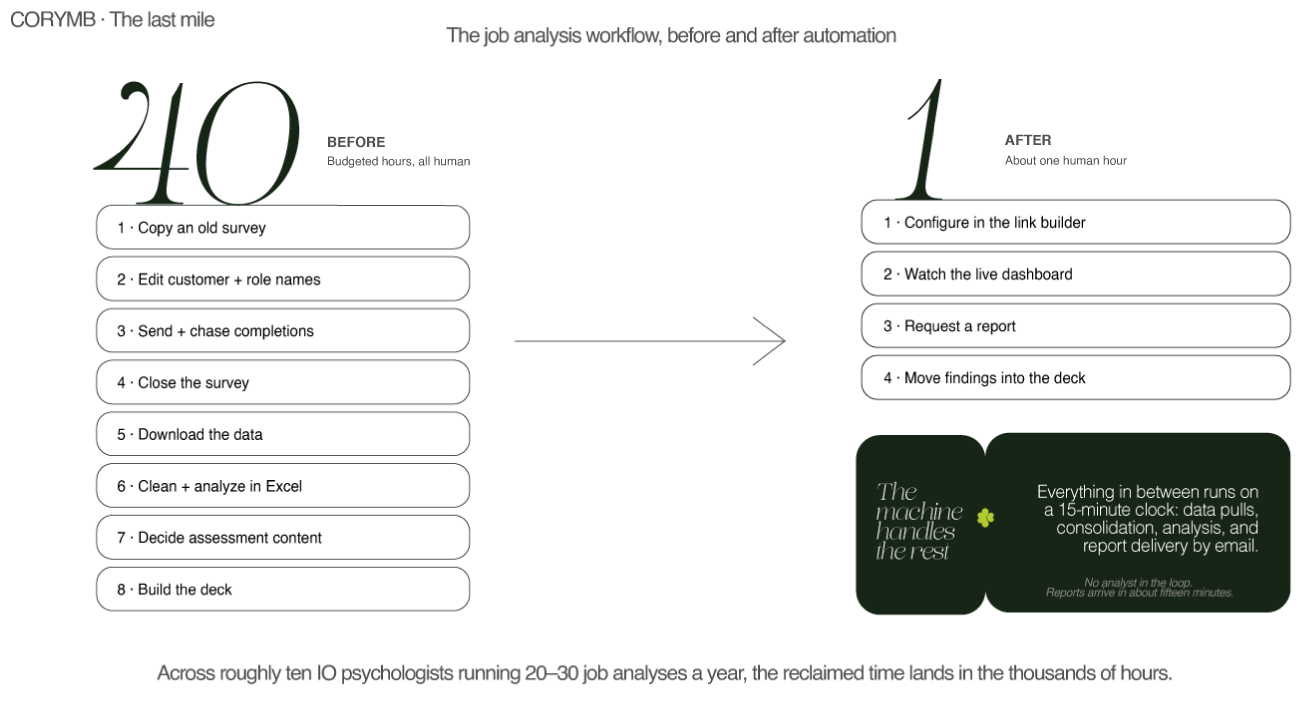
In 2019, running one at Hirevue meant a gauntlet. The consultant went into Qualtrics, found an old survey to copy, and edited the customer and role names by hand. Then came sending it out, watching completions, closing the survey, downloading the data, and cleaning and analyzing everything in Excel before the findings could move into a slide deck. Hirevue budgeted 40 hours per assessment for that work.
Tedium invites errors, and some escaped. In one case, a misapplied Excel averaging formula scrambled which competencies rated as critical for a role. The wrong recommendation went into a deck, the deck went to the client, and the client pushed back because the results made no sense. The consultant retraced the work, found the formula, and corrected the recommendation.
Week one
Colin Willis joined the Customer Science team in April 2019.

Colin Willis
Corymb co-founder
“I broke as soon as I joined Hirevue. […] Literally, if not my first day, by the end of the first week, I had wrapped my head around what current practice was, reviewed the documentation, and started writing the first version of my automation code.”
This was years before AI assistants could write that code alongside him, so every hour of building had to beat the hours it would save. “At the time, that was a big investment,” he says. “There was a real balance of effort calculation: how much time could I save relative to how much time would it take for me to save it?”
He also knew adoption would decide everything. “A technical process would not survive the test of time. A new process had to be easier and more valuable than the current process in order to displace it.”
One survey, treated like software
The design turned on a Qualtrics feature most users ignore: embedded variables. Instead of a copied survey per job, everyone would use a single survey. The customer’s wording arrives through variables, which also control which sections appear and how each response gets tagged for later analysis.
Colin Willis
Corymb co-founder
“I was essentially treating the backend of Qualtrics as a database and the frontend as a customizable software interface.”
His colleagues didn’t need to understand that layer. “They just needed something easier to use and something that produced something of value.” Colin says
Configuring those variables meant hand-editing URL strings, exactly the kind of fiddly work that produces errors. So he built a link builder in a Google Sheet: open-text fields and dropdown choices that walk a consultant through survey configuration like a tutorial. It’s a design instinct that shows up in everything Corymb builds now: the tool teaches its user.
The carrot was the report. He coded an Excel workbook that contains every analysis a consultant would have done by hand, ordered with the highest-priority information first and shaped to drop into the Google Slides decks the team already built. “They got a nice carrot to switch over to my system: their work was done for them, and it was done right.”
He didn’t build the first version alone. Brittany Clapp, the industrial engineer who later co-founded Corymb with Colin, mapped the team’s disparate data systems together and coded the data to add intelligence to the platform. With her help he mapped every role to O*NET, the standardized occupational taxonomy. Customer jobs now shared one language, and the team’s consulting data joined Hirevue’s assessment records in a single place. She also worked the change management side, walking the team into its new process.
Version one was honest duct tape, “definitely slapped together in a lot of ways,” and it had a single point of failure. “Its main bottleneck was me.” Colin triggered every report himself: call the Qualtrics API, download the data, run the analysis scripts. Even so, within a few months of his start date the team had switched over eagerly, while he learned the job and carried a full client load.
The acquisition that finished the job
For the next few years, the survey and the automation evolved together, and new capabilities stayed cheap: extra fields one month, alternate survey content the next. The full overhaul Colin imagined stayed on the shelf, because the effort math had reversed. Running reports cost him minutes a week; a rebuild would cost months.
The push arrived in May 2023, when Hirevue acquired ModernHire, whose survey-based job analysis practice was as manual as Hirevue’s had been in 2019. Colin volunteered to integrate the two systems, binding hundreds of old one-off surveys into the unified dataset and finally building the version he had shelved: user-driven automation. “IOs are really picky about their reports,” he says, so the configuration controls he had built for himself moved into a Qualtrics request form any consultant could fill out. A report ingestor translates the answers into filters and joins, runs the analysis, and emails the finished workbook back, typically within about fifteen minutes. A request can draw on a live engagement or on nearly a decade of history: hundreds of customers, hundreds of jobs, tens of thousands of responses. A scheduler he calls the clock runs it all from an Amazon workspace, checking for new data and new requests every fifteen minutes. Nobody triggers anything, including Colin.
What forty hours buys
The work Hirevue budgeted 40 hours for now takes about one: set up the survey, monitor completions, request a report, move the findings into a deck. The team generally staffs around ten IOs, each running 20 to 30 job analyses a year, so the arithmetic lands in the thousands of reclaimed hours annually. The figure Colin reports publicly, about 800 hours a year, is deliberately conservative.
The error rate fell with the hours. The system runs the same steps the same way every time, so the class of mistake that once scrambled a client’s competency rankings stopped reaching clients at all. The analysis a consultant once rebuilt by hand in Excel now arrives already consistent, every time, for every customer.
Capacity moved with it. During peak demand the team could take on more client work without hiring simply to keep pace. Hirevue could point its hiring where clients feel it: customer-facing talent.
Colin Willis
Corymb co-founder
“It truly was transformational for the team. We could each focus on areas of interest, specialize, develop.”
A week of data chores per assessment went back to science. For Colin, the reclaimed time funded research on neurodivergent hiring alongside a full client load, a collaboration that continues today.
Then there is the dataset. Years of consistent, standardized job analysis data, accumulating on a fifteen-minute clock, became a product engine for the company. Three Hirevue products stand on it. HireVue Builder was named a Top HR Product of 2021 by Human Resource Executive.² The Agile Mindset Assessment took the same award in 2023.³ Assessment Builder launched in February 2026, generating role-specific, validated assessments in minutes.⁴ Colin was deeply involved in building all three. An automation project that began with one consultant refusing to repeat tedious work ended up under the company’s product line. Nathan Mondragon, who led the team during those years, put the contribution plainly:
“Colin and Brittany truly made a difference for our team and organization with their efforts and expertise.”
Built to be left
Colin left Hirevue in April 2026 to run Corymb full time. On his way out, he rewrote the system’s documentation into a handbook that includes, without ceremony, a section titled “How To: Switch to a New Google Account”, a checklist for replacing himself. His successor has run the system since. “She so far has kept it running without needing me for anything.”
The system crossed the last mile twice: once when ten busy specialists adopted it within months, and again when its builder walked out the door and nothing broke. The tools have changed since 2019; Corymb now builds with AI in the loop from day one. The method has not needed the update: start where the work actually happens, make the new way easier than the old way, and engineer for the day you are no longer there.
This story is part of The Last Mile, a Corymb series on a single question: what does the final stretch of AI and work transformation actually look like? Corymb builds custom tools and automation around how people already work. Every engagement starts with a conversation about the problem: discovery@corymb.ai.
References
Sanchez, J. I., & Levine, E. L. (2012). The rise and fall of job analysis and the future of work analysis. Annual Review of Psychology, 63, 397–425. https://doi.org/10.1146/annurev-psych-120710-100401
HireVue. (2021). HireVue Builder named 2021 Top Product by HR Executive Magazine [Press release]. https://www.hirevue.com/press-release/hirevue-builder-named-2021-top-product-by-hr-executive-magazine
HireVue. (2023, August 29). HireVue’s Agile Mindset Assessment recognised as a Top HR Product by Human Resource Executive [Press release]. https://www.hirevue.com/press-release/hirevues-agile-mindset-assessment-recognised-as-a-top-hr-product-by-human-resource-executive
Hirevue. (2026, February 19). Hirevue launches Assessment Builder to scale validated skills hiring across enterprises [Press release]. https://www.hirevue.com/press-release/hirevue-launches-assessment-builder-to-scale-validated-skills-hiring-across-enterprises
